Where there's space - there's possibility

Leave Your Message
Where there's space - there's possibility
When you're trying to pick the best prefab concrete manufacturers in China, it’s important to remember that it’s not just about comparing prices in catalogs. You really need to dig a little deeper—can the supplier turn your approved drawings into consistent, high-quality components? And can they protect those components during shipping? Also, it’s super helpful to ask for clear quality records. You might be looking at products like wall panels, stairs, beams, columns, or even custom pieces. Each of these has its own set of requirements—things like size tolerances, reinforcement details, lifting points, and how everything’s installed.
Details really matter here. For example, the edge tolerance on a panel can impact how well the joints fit on-site, so it’s worth checking that. Curing records and test reports give you a good idea of how controlled their production process is. Don’t hesitate to ask for material specs, inspection procedures, relevant certifications, and even references from past projects that resemble yours. It’s also smart to find out how they handle design changes, who signs off on shop drawings, and whether their export packaging can handle your route and handling equipment. A factory visit or an independent inspection can be super helpful—it can provide peace of mind, but remember, it’s still no substitute for a solid contract review. Little checks like these make a big difference.
This guide is here to help you think about what really matters when evaluating Chinese manufacturers for international projects. Key things like their production capacity, communication, quality assurance, ability to customize, and delivery plans all play a part. Just keep in mind, there’s no one-size-fits-all answer—what’s best depends on your project’s location, local design specs, order size, and how you plan to install the components. Also, a lot of these details might not be easy to verify just by browsing websites—something to be mindful of. Always compare the evidence they provide, ask for written answers, and see if they’re upfront about both their strengths and limitations. Starting with specific questions rather than vague promises is the best way to find a reliable partner.
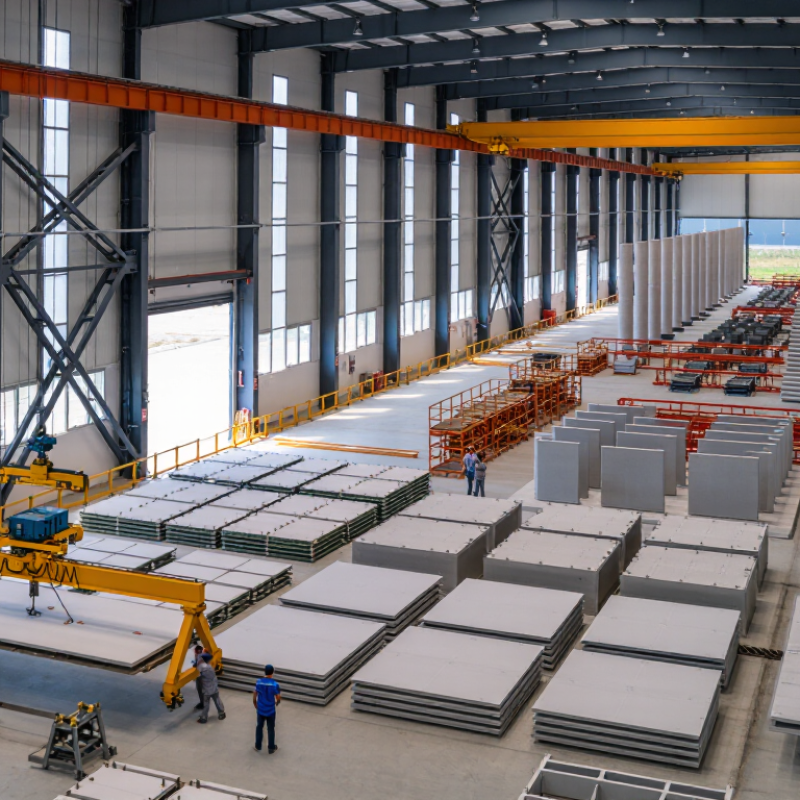
China’s prefabricated concrete industry combines factory production with project-specific engineering. Plants commonly make wall panels, floor slabs, beams, and stairs using reusable steel molds. Workers place reinforcement cages, pour concrete, and monitor curing before checking dimensions and surface quality. The process can improve consistency, but only when drawings, materials, and production records stay aligned. Small deviations matter. A panel that misses its tolerance may complicate installation hundreds of kilometers away.
For global buyers, understanding the manufacturing process is more useful than relying on capacity figures alone. Ask how the factory controls mix proportions, reinforcement placement, curing conditions, and dimensional checks. Request sample inspection records and clarify how products will be packed for transport. A practical review should also compare local project requirements with the supplier’s technical documents; specifications do not automatically transfer between markets. Factory visits can reveal details that brochures omit, such as mold maintenance or storage conditions. Still, a clean production line does not guarantee smooth delivery. Port schedules, packaging, and communication deserve equal attention. This is easy to underestimate. Even experienced teams sometimes discover that installation details were left too late.
| Product Category | Typical Production Approach | Common Applications | Buyer Checks | Shipping and Project Considerations | Relevant Technical Reference |
|---|---|---|---|---|---|
| Hollow-core slabs | Commonly produced on long casting beds using prestressing and extrusion or slip-forming equipment. Longitudinal voids reduce material use and self-weight compared with a solid section of similar depth. | Floor and roof systems in residential, commercial, industrial, and parking structures. | Confirm design loads, span, slab depth, bearing details, openings, lifting points, and the required concrete and prestressing documentation. | Transport length and weight affect route selection and lifting plans. Installation sequence and temporary stability should be coordinated with the project engineer. | EN 1168, Precast concrete products — Hollow core slabs, where applicable to the project. |
| Precast wall elements | Typically cast in reusable molds as solid, sandwich, or other project-designed panels. Reinforcement, insulation, finishes, and embedded items depend on the specification. | External façades, internal partitions, retaining structures, and load-bearing walls. | Review panel dimensions, openings, connection design, reinforcement, concrete finish, insulation requirements, and interface details. | Panel orientation, lifting inserts, edge protection, packing, and unloading equipment should be agreed before production and dispatch. | EN 14992, Precast concrete products — Wall elements, where applicable to the project. |
| Beams and columns | Produced in molds with reinforcement or prestressing designed for the specified structural function and connection arrangement. | Structural frames for industrial, commercial, and other buildings. | Check design drawings, concrete strength requirements, reinforcement details, connection hardware, dimensional tolerances, and inspection records. | Long or heavy members may need special transport permits, lifting equipment, and a coordinated erection plan. | EN 13225, Precast concrete products — Linear structural elements, where applicable to the project. |
| Precast stairs and landings | Cast in stair-specific molds, with geometry and reinforcement set by the approved drawings. Surface finish and nosing details can be specified for the project. | Stair cores and access routes in residential, commercial, and public buildings. | Verify rise and going, overall dimensions, landing interfaces, lifting points, reinforcement, finish, and applicable accessibility requirements. | Confirm stair orientation, access openings, lifting method, and installation sequence to avoid site handling conflicts. | EN 14843, Precast concrete products — Stairs, where applicable to the project. |
| Precast paving units and blocks | Often manufactured by vibration and pressing, then cured under controlled conditions. Mix design and surface treatment vary by intended use. | Pedestrian areas, driveways, public spaces, and other paved surfaces selected for the design loading. | Specify unit dimensions, compressive or other required performance criteria, abrasion or freeze-thaw requirements where relevant, color, and finish. | Agree packaging, pallet configuration, quantity per shipment, and protection against chipping or surface damage. | Applicable product standards and test methods depend on the product type and destination market. |
| Quality and production control | Manufacturing commonly includes batching, mold preparation, reinforcement placement, casting, curing, demolding, and inspection. The exact process varies by product and facility. | Relevant to all precast product categories. | Request project-specific inspection and test plans, material traceability, production records, test reports, and documented procedures for nonconforming work. | Agree hold points, sample approvals, inspection access, document language, and record delivery before the production schedule is finalized. | Applicable standards, contract documents, and destination-country requirements should be identified for each project. |
| Standards and compliance | Product standards and conformity routes depend on the product, intended use, and destination jurisdiction. | All products supplied for international projects. | Check the standard edition named in the contract, required declarations or certificates, test methods, and whether local approvals are needed. | Do not assume that compliance documentation for one market automatically satisfies another market’s requirements. | EN 13369 provides common rules for precast concrete products in relevant European standard frameworks; confirm applicability and current project requirements. |
Product descriptions are general industry information, not project-specific design advice. Dimensions, tolerances, performance criteria, certifications, and applicable standards must be confirmed in the approved project documents and destination-market regulations.
Ready-mix concrete must remain workable from batching through transportation, pumping, and placement. Ultrafine admixtures can help meet this challenge by refining the particle-size distribution of the mix. Fine particles fill spaces between cement grains, supporting a cohesive concrete that is easier to handle and less prone to segregation. A composite made with ground granulated blast-furnace slag (GGBFS) and fly ash can also help maintain consistent slump during delivery, giving crews more time to place and finish concrete efficiently.
Beyond fresh-concrete performance, these supplementary materials contribute to long-term durability. GGBFS and fly ash react with cement hydration products over time, helping create a denser internal structure that can reduce pathways for water and other aggressive agents. This can support dependable strength development and improve resistance to environmental exposure when the mix is properly designed and cured. For concrete producers in China, a purpose-formulated ultrafine powder offers a practical way to balance workability, pumping performance, and durable service life across a range of ready-mix applications.
Common products include beams, columns, floor slabs, wall panels, stairs, façade units, pipes, and drainage culverts. Hollow-core slabs can span rooms with relatively light floor assemblies. Fit matters.
Check load requirements, connection details, local dimensions, transport limits, and installation needs. A large panel may not suit a site with narrow access or limited crane reach.
Include concrete strength, dimensional tolerances, surface finish, reinforcement details, and lifting points. Ask for inspection records, too. Small differences can complicate installation.
Use the same technical checklist for each bidder. Compare production capacity, mold flexibility, quality controls, packing methods, and recent shipments—not price alone.
Request mix designs, reinforcement details, sample inspection reports, and a factory video. It should show mold preparation, concrete placement, curing, and checks on finished units.
A 2019 industry analysis estimated modular construction could shorten timelines by 20–50% and reduce costs by up to 20%. These figures are not guarantees. Project design, factory capacity, delivery distance, and crane access all matter.
Ask whether panels and pipes have protected edges, clear labels, and suitable packing. Confirm lifting points and drawings match the site installation sequence. Details travel badly when overlooked.
No. Factory visits or independent inspections can help verify records against real components, but they add time and cost. I may be giving paperwork too much weight; it cannot show every production issue.
China’s prefabricated concrete industry serves a wide range of construction needs, from residential buildings and commercial facilities to infrastructure projects. Its product categories may include wall panels, floor slabs, beams, columns, stairs, and modular components, each designed for specific structural and installation requirements. Leading manufacturers differ in production scale, technical expertise, customization options, and experience supporting overseas projects. Buyers can assess these capabilities by reviewing manufacturing processes, quality control procedures, material traceability, and consistency between approved designs and finished products.
For international projects, it is important to confirm that products and documentation meet the relevant project standards and certification requirements. A careful supplier comparison should consider product suitability, engineering support, production capacity, lead times, communication, and total delivered cost—not price alone. The sourcing process typically covers specifications, drawings, samples or approvals, production planning, inspection, export packaging, shipping arrangements, and delivery coordination. Clear communication and early planning can help global buyers manage quality expectations, transportation risks, and installation schedules when sourcing Prefab Concrete products from China.





 Send
Email
 Phone